Skip to content

Pricing

Published, fixed. You see the fee before a trade sees the plans.

This fee buys the quantities: a bill of quantities, the source of each line, and an accuracy class stated up front. It does not buy a contract price, and it does not buy a discount negotiated behind a quote. Where a report shows a dollar amount, that amount is quantity times a stated rate — not a trade's offer.

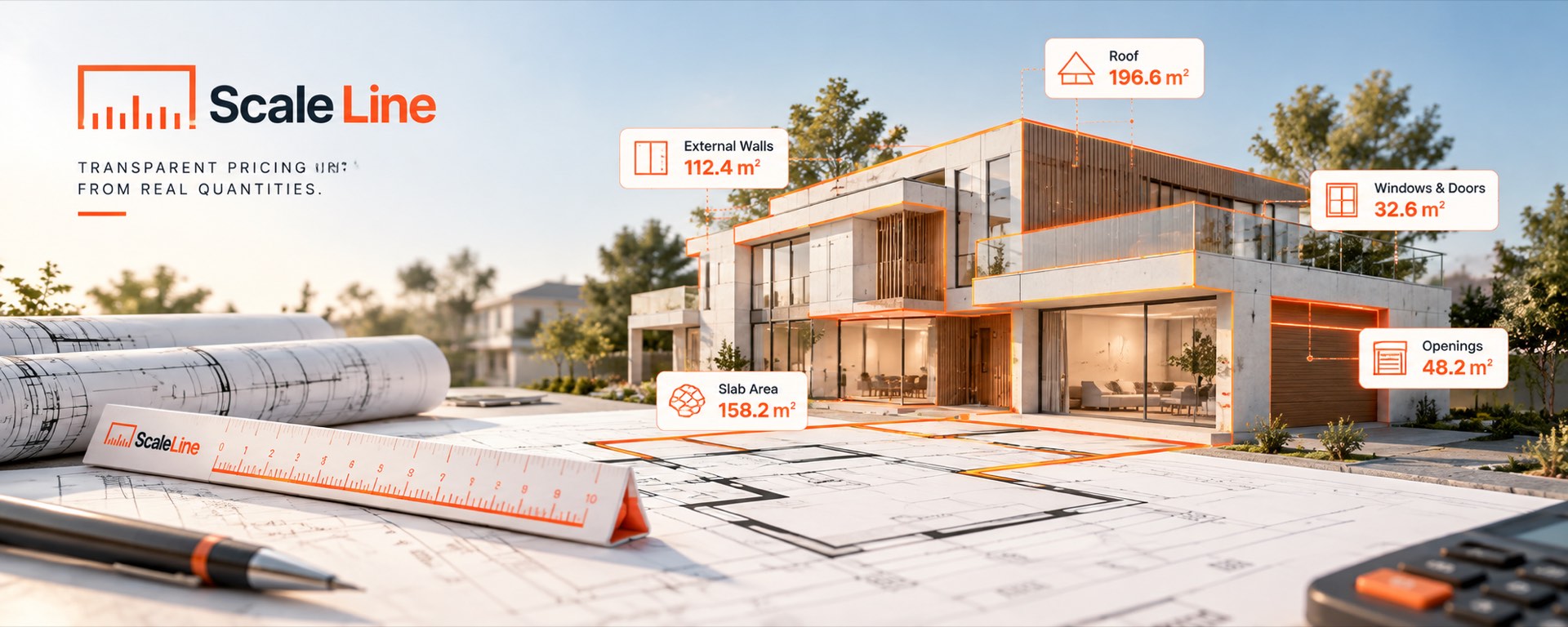
A modern home rendered from its plans, with ScaleLine's measured quantities called out — slab area 158.2 m², external walls 112.4 m², roof 196.6 m², windows & doors 32.6 m² and openings 48.2 m² — above the line 'Transparent pricing from real quantities.'

Plans

Pay for the measure. Don’t pay to find out the fee.

Three ways to buy — one trade, a whole home, or a monthly run of jobs. The price is on the page, before you send a drawing.

A clipboard, calculator and pen on a timber desk. The sheet is a decorative stand-in; its small print is not the published prices.

Single trade

$449 per trade package

One trade, measured from your drawings with full source references. The quantity is fixed and yours — price it knowing the number can’t move to protect someone else’s margin.

  • One trade package (e.g. external walls, slab, framing)
  • Sourced quantities + accuracy class
  • PDF report + Excel/CSV take-off
  • 24–48 hour delivery

Monthly

$3,900 per month

Your outsourced estimating department. A set number of whole-home take-offs every month, at priority turnaround.

  • 3 whole-home take-offs / month (extra jobs $990 each)
  • Priority 24-hour turnaround
  • Carry-over of unused jobs (one month)
  • Direct line to the estimators who measure your jobs

A month on the plan

Say three new homes break ground this month. Each one goes out as one of the plan’s 3 whole-home take-offs, with priority 24-hour turnaround so the BOQ is back before the first trade meeting. A fourth start that same month doesn’t wait for next month’s quota — it runs through at the $990 extra-job rate on the same plan card. A quieter month, where only two homes start, isn’t wasted either: the unused slot carries over one month, so it’s there when the pipeline picks back up. The quantity on every one of those jobs is fixed before a trade prices it — so your margin isn’t riding on a number someone else could have padded.

Using our trades does not change this fee, and skipping them does not either. Collecting quotes is free. We do not mark quotes up. If a trade wins the work, they pay a success fee on their own contract value. We do not publish the percentage. Who pays is on the fairness page.

All figures ex GST.

Side by side

What each fee actually states. A dash means that plan doesn’t list it.

Scope

Single trade
One trade package (e.g. external walls, slab, framing)
Monthly
—

Evidence

Single trade
Sourced quantities + accuracy class
Monthly
—

Depth

Single trade
—
Monthly
—

Files

Single trade
PDF report + Excel/CSV take-off
Monthly
—

Turnaround

Single trade
24–48 hour delivery
Monthly
Priority 24-hour turnaround

Monthly terms

Single trade
—
Monthly
Carry-over of unused jobs (one month) · Direct line to the estimators who measure your jobs

What the fee covers

What you’re paying for — and what you’re not.

One fee, the whole take-off. We measure, so we can’t lift a quote by touching the price.

A kraft paper folder open on a desk with a neat stack of printed schedules inside, a scale rule and a red pen beside it.

Included

  • Trade-by-trade bill of quantities
  • Review by a local estimator
  • Source page, dimension & confidence on every line
  • PDF report + Excel/CSV
  • Quantities that are yours to keep

Not included

  • Pricing or rates — you price it with your trades
  • Choosing suppliers or subbies
  • Anything to do with the building contract

We measure, we don’t price. See where a measure is firm — and where we say it isn’t → >

This page covers the fixed fee for your numbers — the measurements. Getting real quotes against them is a separate step: we don't add a markup, and how the success fee works is set out on our fairness page.

After delivery

What happens once the take-off is in your hands.

The site does not stop at the PDF. This is the ongoing workflow — from pricing the first BOQ through drawing changes to the next home on your board.

  1. 01

    Report lands

    PDF plus Excel/CSV: trade-by-trade quantities, source page and accuracy class on every line. The fee covers measurement only — pricing stays with you and your trades.

  2. 02

    You price or brief trades

    Export the BOQ to your spreadsheet or send the frozen quantities to subbies. Optional Trade Quotes runs the same numbers to independent trades — we pass quotes through, we do not rank them.

  3. 03

    Drawings change

    Revision set, client variation, or late consultant issue — send the updated sheets. We re-issue against the same scope rules so you can see what moved, not start from zero.

    Re-issue SLA: TODO(EVIDENCE)

  4. 04

    Next job enters the queue

    Per-job fee or a monthly slot — same intake, same report shape. Your library of take-offs grows; cross-job comparison stays on quantities you can trace, not memory.

    Jobs per month on retainer: see Monthly plan

  5. 05

    Monthly rhythm (optional)

    On the $3,900 monthly run, priority turnaround and a direct estimator line keep quoting cadence steady. Unused slots carry one month — workflow continuity, not a promo code.

Illustrative workflow — not a service-level guarantee until stated in your order confirmation. Turnaround figures: TODO(EVIDENCE) where not published on the plan card.

Optional trade quotes on the same quantities → Why builders stay on the monthly run →

A fair question

Why aren’t you the cheapest?

Because we don’t touch your money, and we don’t take supplier kickbacks. A take-off that also prices your job is how a measure and a margin get mixed. We keep them apart.

Some services get you a discount by running your spend through their supplier accounts. We don’t. That keeps us neutral — the prices you get back from each trade are the real market, not a figure a middleman negotiated for you and you can’t see the makeup of. You save by having trades compete on the same set of numbers, and those numbers are yours to reuse on the next job. What you’re paying us for is submission-grade depth, a local estimator’s review, and a measure that’s nobody’s but yours.

The way you save isn't a discount we negotiate for you — it's real competition from vetted trades, all pricing against the same numbers.

A trade quote above or below a figure in the report is the market, not a failed measurement. Check the quantities with a blind test on a job you have already built. Check the prices by reading the quotes — originals attached — or by sending the same frozen quantities to your own subcontractor.

Real market prices, measured once, yours to reuse.

More on this in the FAQ →
Quick answers

Three things to settle before you send a drawing.

What exactly do I get, and in what format?

A bill of quantities for the trades you nominate — line by line, each with its source drawing page, the dimension used, a confidence figure and a stated accuracy class. Delivered as a PDF plus an Excel/CSV you can price however you like.

Monthly vs per-job — which is for me?

Per-job suits the odd tender; monthly suits builders quoting steadily who want priority turnaround and a set number of jobs. If you’re unsure, start with one job.

Do you price the work, or just measure it?

We measure. You price it with your own subbies and suppliers. Because we never set the rate, a higher quote is a higher rate — not a quantity we changed to make a price.

All questions →

Send the plans when you know the fee.

The price is published. If you’d rather see our measure against a job you already know, test us first.